


Scientific Activities

-
Scientific Activities

-
Scientific Programs
Scientific Programs
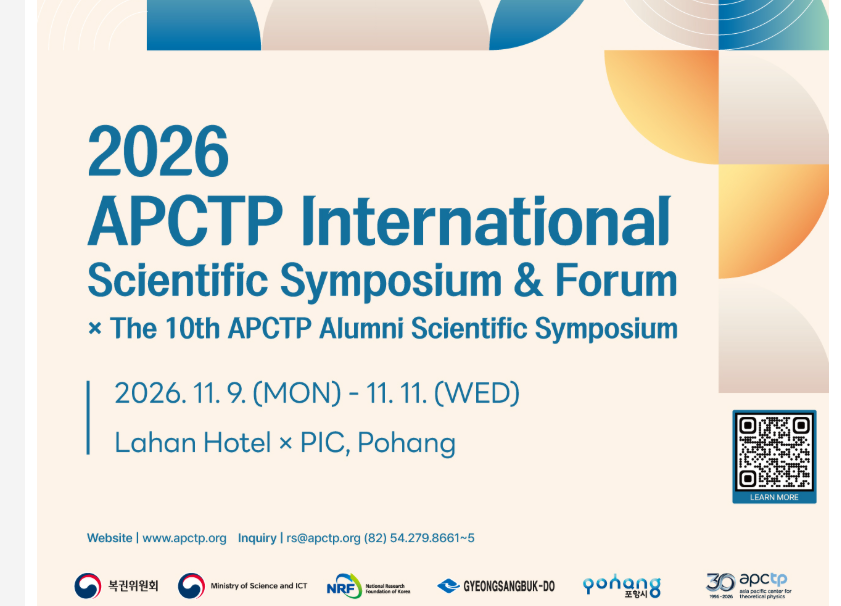
| Poster Image |
|
|---|---|
| Title | 2026 APCTP International Scientific Symposium & Forum |
| Place | Lahan Hotel Pohang, Korea & POSCO International Center |
| Date | 2026-11-09~ 2026-11-11 (Registerable Date : ~ 2026-07-16) |
| Activity Code | |
| Organizer |
Misao Sasaki (
APCTP) Jae-Hyung Jeon ( APCTP) Heribertus Bayu Hartanto ( APCTP) Shohei Okawa ( APCTP) |
| Schedule | |
| Schedule - File #1 | Schedule(Nov9-12).pdf |
| Schedule - File #2 |
 11.9-12.png |
| Talk List | |
| Talk List - File #1 |
 Talk Details(Nov.9-11).jpg |
| Talk List - File #2 | Talk Details(Nov.9-11).pdf |
| Talk Details |
Plenary Talk 1. Is Physics Timeless ? Jan-Michael Rost (MPI-PKS) [Abstract] To find a common origin for different concepts used in the theoretical description of nature has been a lasting motivation to evolve theory in physics. Here, we argue that time and temperature originate from a stationary global entangled state of a system and its environment. Time evolution emerges in the relation of system and environment when separating them [1] and the time-dependent Schrodinger equation follows as a consequence. Imaginary relational time gives rise to temperature and the canonical ensemble for the system, if the global state is maximally entangled [2]. Again, what one normally starts with follows as a consequence in the end: the thermodynamic relation. Time permitting I will sketch how the same idea can be applied to photons where a quantized photon field is the (time-independent) starting point and the familiar electromagnetic field emerges turning entanglement into coherence. [1] Sebastian Gemsheim, Jan M. Rost, Phys. Rev. Lett., 131, 140202 (2023). [2] Sebastian Gemsheim, Jan M. Rost, Phys. Rev. D, 109, L121701 (2024). Plenary Talk2. Observing the Big Bang Ana Achucarro (Leiden Univ.) [Abstract] Cosmologists practise an extreme form of archaeology, because looking through a telescope takes you back in time. In the last 30 years, after some remarkable discoveries, they have pieced together a history of the universe that could take us back to a fraction of a second after the big bang. We can view the birth of the universe as a giant “cosmological collider” event, at ultra-high energy, whose products are still imprinted in the sky today and could be detected with telescopes, provided we know what to look for. Talk 1. Zero-Clustering Geometry in Fractional Quantum Hall Effect Xin Wan (Zhejiang Univ.) [Abstract] Geometrical properties in fractional quantum Hall systems have been attracted growing interest. They accompany the topological properties, such as the clustering pattern of zeros in ground state, but have long remained overlooked. In this talk, I emphasize geometrical fluctuations of the zeros around individual electrons and propose to use the displacement ratio of the zeros to visualize and measure the distance of a realistic state to a model wave function. The distribution of the zero displacement ratio behaves like an order parameter in the transition from a Laughlin phase to a topologically trivial one. The statistical comparison between quantum Hall states belonging to different Jain sequences leads to a composite fermion fluid description of the 1/5 ground state with long-range Coulomb interaction that agrees almost perfectly for as few as 3-5 electrons, overcoming the long-standing difficulties of accommodating the competing liquid and crystal orders at short distances. Talk 2. Exotic magnetism in (111)-oriented manganite superlattices Igor Di Marco (Nicolaus Copernicus Univ, in Torun) [Abstract] In this presentation, I will discuss the unusual properties that emerge in LaMnO3-based superlattices grown in the (111) crystallographic orientation. I will first focus on (111)-oriented superlattices of LaMnO3 and SrMnO3, two antiferromagnetic insulators. First-principles electronic-structure calculations show that these heterostructures can stabilize a half-metallic ferromagnetic state for substantially thicker constituent regions than in their (001)-oriented counterparts. The magnetization profile indicates that this ferromagnetism is not primarily interface-driven, but instead emerges from the combined effects of epitaxial strain and octahedral connectivity along the [111] direction. Multiscale modelling based on an effective Heisenberg Hamiltonian further predicts long-range magnetic order up to 220 K, suggesting experimentally accessible conditions and potential relevance for spintronic applications. In the second part of my presentation, I will discuss (111)-oriented superlattices of LaMnO3 and SrTiO3, an antiferromagnetic insulator and a nonmagnetic insulator. These systems are predicted to host an intrinsic ferromagnetic insulating state arising from the interplay of structural order, strain, and quantum confinement. The analysis of orbital ordering and interatomic exchange interactions points to a Kugel-Khomskii-type superexchange mechanism. Owing to the scarcity of ferromagnetic insulators, these oxide superlattices may provide a promising platform for spin-filter barriers, spin-polarizing elements, and other spintronic functionalities. Talk 3. Information-Geometric Mapping of Renormalization Group Ki-Seok Kim (POSTECH) [Abstract] This study presents an information-geometric framework mapping the Functional Renormalization Group (FRG) flow in the parameter space $\mathcal{M}_{\mathrm{param}}$ to Dyson's Brownian motion in the spectral manifold $\mathcal{N}_{\mathrm{eigen}}$. Both processes are formulated as gradient flows on the second Wasserstein space of probability measures $\mathcal{P}_2(\mathbb{R})$, satisfying Perelman's modified Ricci flow equations. For non-integrable systems, the flow converges to a shrinking gradient Ricci soliton where the Ricci curvature satisfies the lower bound $\mathrm{Ric} \ge \kappa > 0$. This geometric convergence restricts the spectral density to the invariant measures of Random Matrix Theory (RMT), defining the spectral condition for the Eigenstate Thermalization Hypothesis (ETH). The boundary of this framework is evaluated in Kolmogorov-Arnold-Moser (KAM) regimes, where the pullback mapping exhibits rank deficiency, and the non-gradient currents are parameterized by a Bismut-Ricci flow extension incorporating a closed 3-form torsion tensor. Talk 4. What Makes a Metal Strange Yili Wang (APCTP) [Abstract] Strange metals are among the simplest systems in which our conventional understanding of metallic behaviour seems to break down. Their unusual transport properties raise a broader question, that what kind of quantum dynamics can emerge when the familiar picture of long-lived quasiparticles fails? I will approach this question from several directions, starting with the role of spatial randomness in transport, then turning to quantum chaos and SYK-inspired models, and finally to the surprising connection between strongly interacting quantum matter and spacetime geometry through ER=EPR. Along the way, I will discuss how these seemingly different perspectives may be connected, and what they leave us still wondering about strange metals and strongly coupled quantum systems. Talk 5. Describing Quantum Gravity with Overlapping Qubits Alexander Jahn (APCTP) [Abstract] In recent years, methods of quantum information theory have allowed us to approach quantum gravity from a new angle. In particular, these methods allow us to study how quantum information is encoded and processed in quantum-gravitational systems while relying only on general assumptions about the full theory. In this talk, I will introduce our recent work on using the formalism of overlapping qubits - qubits whose operators exhibit small non-local non-commutativity - to describe the quantum-gravitational effects on the semiclassical Hilbert space structure of effective field theory. I will focus on two settings in which this approach describes interesting physics: Expanding de Sitter spacetime, in which the number of effective degrees of freedom appears to increase exponentially with time, and evaporating black holes, where quantum-gravitational effects are expected to allow information from the black hole interior to be gradually revealed to the exterior. Talk 6. Recursion Relations for Classical Gravity Kanghoon Lee (KIAS) [Abstract] Gravitational waves provide a unique window into spacetime dynamics, yet interpreting their signals requires solving Einstein’s nonlinear equations. I will introduce gravitational-wave physics and outline several approaches to this challenge, including perturbative expansions and modern scattering-amplitude methods for extracting classical gravitational dynamics. I will then discuss my recent work on recursive approaches to classical gravity, which build higher-order contributions systematically from simpler building blocks. These developments reveal how techniques from quantum field theory can offer new ways to organize and solve classical problems in general relativity. Talk 7. Leptoquark-Assisted Baryogenesis Grucharan Mohanta (APCTP) [Abstract] We discuss a class of baryogenesis scenarios in which the Standard Model is extended by heavy right-handed neutrinos (RHNs) and a scalar leptoquark. The out-of-equilibrium, CP-violating decays of the RHNs into quarks and leptoquarks generate a net $B-L$ asymmetry, which is subsequently converted into a baryon asymmetry through electroweak sphaleron processes. Unlike standard type-I seesaw leptogenesis, the CP-asymmetry parameter $\epsilon$ is not directly bounded by the light-neutrino masses. The Davidson–Ibarra bound can therefore be avoided, making successful baryogenesis possible for RHN masses below $10^9~{\rm GeV}$. We illustrate this mechanism using the scalar leptoquark $\bar S_1\sim(3,1,-2/3)$, which has the diquark interaction $\bar S_1\,\overline{d_R^C}d_R$. Together with the leptoquark coupling to the RHNs and active--sterile neutrino mixing, this interaction can induce proton decay. We calculate the relevant proton-decay rates and branching fractions and derive constraints on the diquark couplings. Finally, we examine the complementary constraints arising from Big Bang nucleosynthesis, ATLAS searches for long-lived $R$-hadrons, and the sensitivity of Super-Kamiokande proton-decay searches. Talk 8. Beyond Fractional Brownian Motion: Heterogeneous Diffusion, Diffusing Diffusivity, and Fluctuating Hurst Exponents Aleksei (Oleksii) Chechkin (MPI-MSP) [Abstract] Anomalous diffusion is ubiquitous in heterogeneous complex systems, where fluctuations of the local environment can lead to non-Gaussian statistics, anomalous scaling, and nontrivial temporal correlations. Fractional Brownian motion (FBM) provides a paradigmatic description of anomalous diffusion, but its fixed diffusivity and Hurst exponent impose idealizations that are often violated in real systems. We discuss stochastic extensions of FBM that incorporate these sources of heterogeneity. We first consider diffusing diffusivity, in which the diffusion coefficient fluctuates in time. Comparing different representations of FBM with diffusing diffusivity reveals markedly different statistical behaviors, including unexpected crossovers in mean-squared displacement and increment statistics, as well as a transition from short-time non-Gaussian to long-time Gaussian displacement statistics. We then turn to fluctuations of the Hurst exponent. Random variations of the exponent can produce accelerating diffusion and transitions between persistent and antipersistent behavior. Allowing the exponent to fluctuate in time leads to telegraphic multifractional Brownian motion, providing an analytically tractable model of stochastic multifractionality. Together, these results suggest a broader view of anomalous diffusion in which both diffusivity and scaling properties may themselves become stochastic. Talk 9. Probe critical ice nuclei via nano-sized substrates Xin Zhou (CAS) Critical nuclei, as the transition state of the first order phase transitions, such as crystallization of supercooled water, are hard to directly observe by experiments even simulation, owing to the transient, nanoscale, rare and random nature simultaneously. We theoretically show, verified by simulation and experiments, critical ice nuclei can be stabilized on nanosized ice-affine substrates in macroscopic timescales, either melting or freezing but remaining the critical sizes, shapes and ice-water interfaces at supercooling, while the size of substrates is smaller than that of critical nuclei. By contrast, when the size of substrates is equal to (or larger than) that of critical nuclei, freezing irreversibly occurs. We applied the approach to experimentally probe the temperature-dependent sizes of critical nuclei. Talk 10. Correlated disorder: towards messy metamaterials Mathias Casiulis (APCTP) [Abstract] From bird feathers to beetle exoskeletons or mandrill skin, we are surrounded by natural structures selected for their optical properties. Yet, unlike artificial structures like photonic crystals, many of these systems lie far outside the realm of periodic materials. Instead, they rely on long-range correlations in otherwise disordered media to achieve desirable properties, like structural color or photonic bandgaps. Taking inspiration from nature, can we design new disordered structures with tuned correlations? In this talk, I will discuss strategies to do so, ranging from non-equilibrium steady state dynamics to spectral optimization. I will then illustrate outcomes using hyperuniform structures and gyromorphs, two classes of systems that display exciting optical properties while lacking translational order. Talk 11. Quantum batteries: How decoherence and collectivity shape their performance Gentaro Watanabe (Zhejiang Univ.) [Abstract] Quantum batteries, one of the key elements of future quantum technology, are energy-storage devices composed of quantum systems. They have recently attracted considerable attention as a promising paradigm for energy storage with quantum enhanced performance [1]. Central questions concerning the performance of quantum batteries are: How fast can we charge them using quantum effects? And how much of the stored energy can actually be extracted? In this talk, we discuss our recent results addressing these questions [2-4]. First, we show that a moderate amount of decoherence, usually regarded as detrimental to quantum systems, can in fact accelerate the charging of quantum batteries [2, 3]. Second, we discuss how collectivity affects the extractable fraction of stored energy and establish a universal scaling law governing its approach to unity in the many-battery limit [4]. Talk 12. On Dark Energy Reconstruction and Interpretation Arman Shafieloo (KASI) [Abstract] Reconstructing the expansion history of the universe and the properties of dark energy has been a central goal in physical cosmology, with far-reaching implications for our understanding of fundamental physics. In this talk, I will discuss different approaches of reconstructing dark energy properties, assess findings from the latest observational data such as DESI DR2 and discuss potential advancements in the field that may enhance our understanding of the universe’s fundamental dynamics. I will also discuss the possibility of Phantom Crossing in the equation of state of dark energy considering recent cosmological observations. Talk 13. Primordial Black Holes in the early Universe Alberto Escriva (APCTP) [Abstract] Primordial black holes (PBHs) are among the most intriguing hypothetical objects in the Universe, with profound implications for cosmology, gravitational physics, and the nature of dark matter. In this talk, I will introduce the basic ideas behind PBHs, discussing how they may form in the early Universe and why they have attracted renewed interest in recent years. I will then review some of the main observational and theoretical implications of their existence, including their possible connection to dark matter and gravitational-wave observations. Finally, I will highlight recent progress in understanding PBH formation and the nonlinear gravitational dynamics that determine when and how these objects can be produced. Talk 14. The interior dynamics and critical behavior of black holes Rong-Gen Cai (Ningbo Univ.) [Abstract] In Einstein-Maxwell theory, the Kerr-Newmann (KN) black hole solution is the most general solution for a stationary and axisymmetric spacetime. In general, the KN black hole has an event horizon and a Cauchy horizon, beyond the Cauchy horizon the predictability is lost. Therefore the Cauchy horizon is believed unstable and will become a singularity with some perturbations. In this talk I will first show a no inner horizon theorem for black holes with charged scalar hairs. Then I will show the Kasner exponent of geometry inside the black hole can be related to the critical behavior of spontaneous scalarization of black holes. There exists a seesaw mechanism between the Kasner exponent and the scalar field at the event horizon. Talk 15. Exploration of Quantum States in 2D Materials and Application in Energy Storage Worawat Meevasana (Suranaree University of Technology) [Abstract] Angle-resolved photoemission spectroscopy (ARPES) is a powerful technique for directly observing the electronic structure with energy- and momentum-resolved information. By experimentally detecting the electronic structure, the fundamental physics can be revealed. In this talk, I will discuss ARPES studies of two-dimensional electron gas (2DEG) in transition metal oxides [1-3] and chalcogenides [4]. The focused quantum effects include negative electronic compressibility and the unique character of strongly correlated systems, specifically Mott-insulators, in the context of advancing battery electrode materials. |
| - File #1 | Alumni Poster.pdf |
| - File #2 |
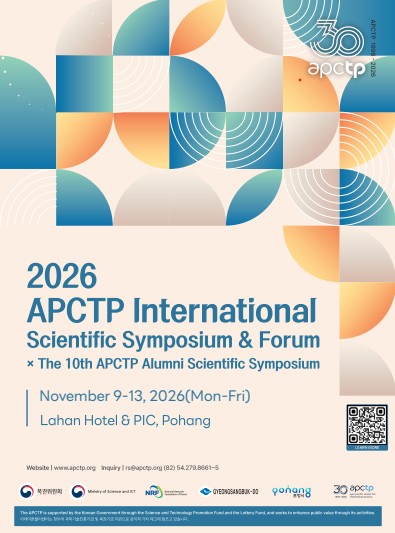 Alumni Poster.jpg |